

Published: | Last updated:
E-invoicing in the UAE means that in-scope invoices, between businesses or from a business to a government entity, become structured XML files sent through a Ministry of Finance accredited service provider (ASP) and reported to the Federal Tax Authority (FTA). A PDF is not an e-invoice. The rule applies whether or not a company is registered for VAT. Two dates matter most: businesses with revenue of AED 50 million or more go live on 1 January 2027, and in-scope businesses with revenue below AED 50 million must appoint an ASP by 31 March 2027 and go live on 1 July 2027.
This guide to e-invoicing in the UAE answers three questions: am I in scope, by when, and what do I need to do now? Every figure comes from official Ministry of Finance (MoF) and FTA texts, including the 2026 amendments that many guides still miss.
What is e-invoicing in the UAE?
In short: A UAE e-invoice is a machine-readable XML file in the Peppol PINT-AE format. It travels from the supplier’s ASP to the buyer’s ASP, and the tax data is reported to the FTA. PDFs, Word files, scans, images and emails are not e-invoices, and there is no QR code.
The Ministry of Finance e-invoicing portal is explicit: unstructured formats such as PDFs, Word documents, images, scanned copies and emails are not e-invoices.
Three technical points define the UAE model:
- Format: e-invoices are issued, transmitted and received in XML, with no QR code or barcode (MoF Guidelines V2.0, section 5.3).
- Standard: each invoice follows Peppol’s PINT-AE specifications, with a published list of mandatory fields.
- Reporting: your ASP reports the tax data to the FTA as part of the exchange.
E-invoicing does not replace VAT invoicing rules. It changes their form. A person subject to the system issues its tax invoices and tax credit notes as electronic documents. Businesses that are not registered for VAT are covered too: their sales documents become “Commercial Invoices” in electronic form.
When must an e-invoice be issued? It depends on your VAT status:
- VAT-registered issuers: the issuing deadlines of the UAE VAT law apply.
- Other issuers: the e-invoice or e-credit note must be issued and transmitted within 14 Business Days of the business transaction (Ministerial Decision No. 197 of 2026, amending Article 6(5) of Ministerial Decision No. 243 of 2025).
| Traditional invoice (PDF or paper) | UAE e-invoice | |
|---|---|---|
| Format | Human-readable document | Structured XML (PINT-AE) |
| Delivery | Email, post, portal | ASP to ASP over the Peppol network |
| Tax reporting | Through the periodic VAT return | Tax data reported to the FTA per invoice |
| QR code | Not applicable | None |
| Sufficient for an in-scope transaction once your phase starts? | No | Yes |
Who must comply with e-invoicing in the UAE?
Short answer: Any person conducting business in the UAE, for in-scope transactions with another business or a government entity, regardless of VAT registration. That includes businesses that only sell to consumers but buy from other businesses.
The Guidelines state that e-invoicing “is mandatory for any Person conducting Business in the UAE, regardless of their VAT registration status, unless specifically excluded.” Your customer’s onboarding or tax status does not change your obligation.
E-invoicing in UAE: the cases most guides miss
1. The B2C trap. Selling only to consumers does not take you out of scope if you buy from other businesses. According to the FTA’s official FAQ, a business that makes only B2C supplies but receives supplies from other businesses must still appoint an ASP and implement the system. A restaurant, clinic or shop that receives invoices from suppliers, a landlord or service providers needs an ASP to receive e-invoices.
2. Non-residents. A person without a place of residence in the UAE that must issue tax invoices under the VAT law must issue them as e-invoices (Guidelines, section 6.3.3).
3. Holding companies. A pure holding company earning only passive income, with no business transactions, is not in scope. Once it recharges costs, such as management fees, those recharges are business transactions and it must onboard in line with its phase (section 6.3.1).
4. VAT groups. Each member of a tax group onboards separately with its own TIN (the first 10 digits of its own TRN). The tax group TIN cannot be used for e-invoicing, and members may choose different ASPs.
- Transactions between members of the same tax group are excluded for 24 months starting 1 January 2027, under Ministerial Decision No. 197 of 2026.
- Transactions with third parties follow the normal calendar.
5. Free zone companies. Free zone businesses are in scope like any other. When the customer is a free zone entity, the e-invoice must also show the “beneficiary”: the person or entity that ultimately uses, consumes or owns what is supplied. For most B2B sales, that is simply the customer.
6. Government suppliers. Supplies to government entities are in scope, including those made through government procurement portals.
What is excluded from UAE e-invoicing?
Short answer: Excluded are sales to consumers (B2C), sovereign government activities, certain airline services and VAT-exempt or zero-rated financial services. Transactions within a tax group are also excluded for 24 months from 1 January 2027.
Article 4 of Ministerial Decision No. 243 of 2025, as replaced by Ministerial Decision No. 197 of 2026, lists the Excluded Transactions:
- Transactions by government entities in a sovereign capacity, not in competition with the private sector.
- International passenger transport by an airline where an electronic ticket is issued, and related services documented by an Electronic Miscellaneous Document.
- International air cargo where an airway bill is issued, for 24 months from the date the system becomes effective.
- Financial services that are VAT-exempt or zero-rated. Standard-rated financial services stay in scope.
- Transactions within a tax group, for 24 months from 1 January 2027.
- Any other transaction the Minister may designate.
Separately, Ministerial Decision No. 244 of 2025 (Article 5(2)) takes B2C transactions out of the system until the Minister decides otherwise, as well as any person engaged exclusively in them.
| Supplier \ Buyer | Business | Government | Consumer |
|---|---|---|---|
| Business | B2B: in scope* | B2G: in scope* | B2C: out of scope (for now) |
| Government | G2B: in scope* | G2G: in scope* | G2C: out of scope |
| Consumer | C2B: out of scope | C2G: out of scope | C2C: out of scope |
*Unless the transaction falls under one of the exclusions above. Source: MoF Guidelines V2.0, section 6.2.
You may e-invoice excluded transactions voluntarily. The technical rules then apply, but the specific e-invoicing penalties do not.
E-Invoicing UAE Deadline and Timeline (2026 to 2027)
Short answer:
- Revenue of AED 50 million or more: ASP by 30 October 2026; go live on 1 January 2027.
- In-scope businesses below AED 50 million: ASP by 31 March 2027; go live on 1 July 2027.
- Government entities: ASP by 31 March 2027; go live on 1 October 2027.
| Phase | Who | Appoint an ASP by | Go live by | Status at 19 November 2026 |
|---|---|---|---|---|
| Pilot | Businesses invited by the Ministry that agree in writing | Not applicable | Since 1 July 2026 | Running |
| Voluntary | Any person, any revenue | Not applicable | Any time from 1 July 2026 | Open |
| Phase 1 | Revenue of AED 50 million or more | 30 October 2026 | 1 January 2027 | Appointment deadline passed |
| Phase 2 | Revenue below AED 50 million | 31 March 2027 | 1 July 2027 | Main deadline for SMEs |
| Government | Federal and local government entities | 31 March 2027 | 1 October 2027 | Upcoming |
| VAT-group internal transactions | Members of the same tax group | Not applicable | Excluded until 31 December 2028 | Temporary exclusion |
Sources: Ministerial Decision No. 244 of 2025, as amended by Ministerial Decision No. 66 of 2026; Ministerial Decision No. 197 of 2026.
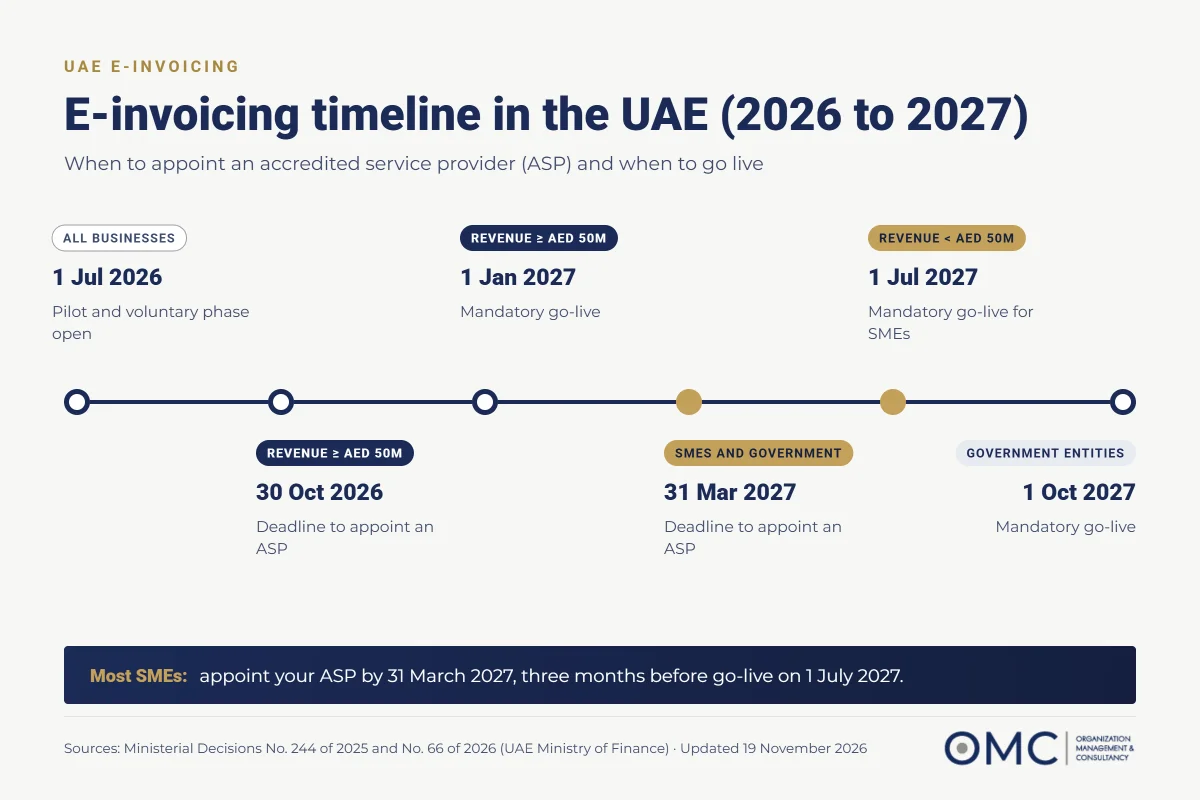
The Phase 1 date moved once. The original ASP deadline for large businesses was 31 July 2026. On 10 May 2026 the Ministry extended it to 30 October 2026 and kept the 1 January 2027 go-live date. Ministerial Decision No. 66 of 2026 made it formal. Two official documents still show other dates: Guidelines V1.1 (31 July 2026) and the table in Guidelines V2.0 (“31st October 2026”). The binding date is the one in the decision: 30 October 2026.
Phase 1 business without an ASP? The deadline has passed, and failing to appoint an ASP is a penalised violation in itself. Act now.
SME? 31 March 2027 is your real deadline. Contracting, EmaraTax onboarding, system changes and testing take time. The ASP date sits three months before go-live precisely to leave room for integration and testing.
How is revenue measured? On gross income for the most recent accounting period, based on financial statements prepared under UAE legislation, or other documentation acceptable to the FTA (Ministerial Decision No. 244 of 2025, Article 1).
How UAE e-invoicing works: the 5-corner model
Short answer: You send invoice data to your ASP. It validates the data, converts it to XML, sends it to your customer’s ASP and reports the tax data to the FTA. Compliance stays with you, not with the ASP.
| Corner | Who | Role |
|---|---|---|
| 1 | Supplier | Sends invoice data to its ASP |
| 2 | Supplier’s ASP | Validates, converts to PINT-AE XML, transmits to Corner 3, reports to the FTA |
| 3 | Buyer’s ASP | Validates, confirms receipt, delivers to the buyer, reports to the FTA |
| 4 | Buyer | Receives the e-invoice in its own system |
| 5 | Federal Tax Authority | Receives tax data and sends confirmations |
The flow, simplified: Supplier → Supplier’s ASP → Buyer’s ASP → Buyer, with both ASPs reporting to the FTA.
What the ASP does, and what stays with you
| Task | Your business | Your ASP |
|---|---|---|
| Calculating invoice values (prices, VAT, totals) | Yes | No |
| Collecting your customer’s Peppol participant identifier | Yes | No |
| Agreeing data security and hosting terms | Yes | No |
| Notifying your ASP when your FTA-registered data changes | Yes | No |
| Secure, encrypted transmission | No | Yes |
| Looking up the buyer on the network | No | Yes |
| Generating a unique UUID per invoice | No | Yes |
| Exchange and reporting | Legally yours | Carried out by the ASP |
The Guidelines say it plainly: the compliance obligation “remains with the supplier (or buyer in the case of self-billed invoices).” Appointing an ASP outsources a process. It does not transfer liability.
What if your customer is not on the system yet? You still issue the e-invoice.
- Buyer that has not yet implemented e-invoicing and has no participant identifier: the Guidelines (section 10.2.2) require the predefined endpoint 0235:9900000098. Where a tax invoice is required, also give the buyer a regular tax invoice (for example a PDF) during the transition.
- Exports to a buyer with no Peppol ID: the predefined endpoint is 0235:9900000099.
Other scenarios, such as deemed supplies, have their own codes. Confirm the right one with your ASP.
How to Choose an Accredited Service Provider for E-Invoicing in the UAE
Short answer: Choose one ASP from the official MoF list to handle both sending and receiving. Before signing, check compatibility with your accounting or ERP system, data hosting and security, support, integration and error handling.
Only accredited providers can act as ASPs. The Ministry of Finance accredits them under Ministerial Decision No. 168 of 2026, in force since 1 October 2026, which repealed Ministerial Decision No. 64 of 2025. Accreditation is valid for two years and can be terminated.
The official list is on mof.gov.ae. At 19 November 2026, the Ministry’s list of accredited service providers contained 88 providers, all with full accreditation. The list changes, so check it on the day you sign rather than relying on a provider’s own claims.
One ASP, both directions. A business in scope must appoint only one ASP for both sending (accounts receivable) and receiving (accounts payable) e-invoices (Guidelines, section 6.1).
A regulatory floor on pricing. Under Ministerial Decision No. 168 of 2026, every ASP must provide 100 free e-invoice exchange and reporting services per year to each end user. Check how each provider counts sent and received documents.
Selection criteria
Drawn from the MoF’s Considerations for Selecting an Accredited Service Provider:
| Criterion | What to ask |
|---|---|
| ERP or accounting compatibility | Native connector, API or file upload for your software? |
| Product ownership | Own platform or resold third-party product? |
| Hosting and data security | Where is data hosted? Which certifications, encryption and access controls? |
| Storage | Will the ASP archive your e-invoices for the legal period? How do you retrieve them? |
| Integration and testing | Who does the work, and how long does testing take? |
| Error handling | How are rejections reported and resolved, and how fast? |
| Support | Hours, language, escalation, service levels during go-live |
| Pricing model | Subscription or per transaction? What is included beyond the 100 free documents? |
| Exit | How do you switch provider and get your data back? |
OMC can help you assess your obligations and coordinate EmaraTax onboarding with a Ministry of Finance-accredited service provider.
Step-by-step: how to get ready for e-invoicing
Short answer: Understand the rules, sign with one ASP, onboard through EmaraTax, obtain your Peppol ID, test, then go live. If you are not registered with the FTA for any tax, register first to obtain a TIN.
Step 1: Map your invoices. Identify your phase and the documents you issue: tax invoices, commercial invoices, credit notes, self-billed invoices. Note special scenarios such as free zone sales, deemed supplies, summary invoices, continuous supplies or exports. Check that your accounting or ERP system can produce every mandatory PINT-AE field.
Step 2: Choose an ASP and sign. Pick a provider from the official list and finalise the contract before onboarding.
Step 3: Onboard through EmaraTax. The business, not the ASP, starts onboarding.
- Check that your trade licence, address and contact details in EmaraTax are up to date.
- The account admin clicks the E-INVOICING tile in the left-hand menu.
- Select your contracted ASP and click “Proceed to ASP”.
- Complete onboarding on the ASP’s portal.
Step 4: Obtain your Peppol participant identifier. It is 0235 followed by your 10-digit TIN. Your ASP shares it once onboarding is complete. Give it to your suppliers so they can e-invoice you.
Step 5: Test. Run the full cycle with your ASP: sending, receiving supplier e-invoices and confirmation of tax data reporting.
Step 6: Go live. Agree an error-resolution process before the date, then monitor rejections closely in the first weeks.
Ongoing: if your FTA-registered data changes, notify your ASP in writing within five Business Days of the FTA confirming the change (Ministerial Decision No. 243 of 2025, Article 5(3)). Examples include VAT registration or deregistration, joining or leaving a tax group, or closing the business.
TIN: what it is and how to get one
Your Tax Identification Number (TIN) is your e-invoicing identifier.
- Registered for any tax (VAT, Corporate Tax or Excise Tax): your TIN is the first 10 digits of your 15-digit TRN.
- In scope but not registered for any tax: register with the FTA on EmaraTax to obtain a TIN.
- Not VAT-registered: show your 10-digit TIN on your e-invoices instead of a VAT TRN.
UAE e-invoicing penalties
Short answer: Penalties are set by Cabinet Decision No. 173 of 2026, which repealed Cabinet Decision No. 106 of 2025. Failing to implement the system or appoint an ASP costs AED 5,000 plus AED 5,000 per month, capped at AED 50,000 in any 12 consecutive months. Voluntary e-invoicing is exempt from these specific penalties.
Many pages still quote Cabinet Decision No. 106 of 2025. It is repealed. The Ministry of Finance announced the replacement on 30 October 2026.
| Violation | Penalty under Cabinet Decision No. 173 of 2026 |
|---|---|
| Failure by the issuer or recipient to implement the system on time, including failure to appoint an ASP; or a recipient’s failure to keep complying after implementation | AED 5,000 for the first instance, plus AED 5,000 per month or part month of continued non-compliance, up to AED 50,000 in any 12 consecutive months |
| Failure to issue and transmit an e-invoice through the system | AED 100 per e-invoice, up to AED 5,000 per calendar month |
| Failure to issue and transmit an e-credit note through the system | AED 100 per e-credit note, up to AED 5,000 per calendar month |
| Failure to notify your ASP of changes to FTA-registered data (deadline: five Business Days after FTA confirmation) | AED 250 per day of delay, up to AED 5,000 per calendar month |
What changed compared with the 2025 decision:
- The fine for failing to report a “system failure” is removed: Ministerial Decision No. 197 of 2026 repealed the underlying obligation.
- The data-change fine fell from AED 1,000 to AED 250 per day, capped at AED 5,000 per month.
- The implementation fine now has a cap of AED 50,000 in any 12 consecutive months.
- One penalty per violation: where the same person is issuer, recipient or both for the same violation, only one penalty applies.
Voluntary users. Voluntary e-invoicing is exempt from the specific penalties under Cabinet Decision No. 173 of 2026 (Article 2(2)). Ordinary tax invoicing obligations continue to apply.
VAT penalties can apply on top. An invoicing failure can also breach VAT or tax procedure rules, triggering the general penalties of Cabinet Decision No. 40 of 2017 and its amendments (Guidelines, section 11.1).
Record keeping and storage of e-invoices
Short answer: Keep e-invoices and associated data for at least 5 years. Real estate records require 7 years, or 15 years where they must be kept under the VAT rules. Since 1 October 2026 the data no longer has to be stored in the UAE, but it must be producible to the FTA on request.
| Situation | Retention period | Source |
|---|---|---|
| Taxable persons | 5 years after the end of the tax period concerned | Tax Procedures Executive Regulation, Article 3 |
| Other persons | 5 years from the end of the calendar year the document was created | Same |
| Real estate records | 7 years from the end of the calendar year the document was created | Same |
| Real estate records required to be kept under VAT rules | 15 years after the end of the tax period concerned | VAT Executive Regulation, Article 71(2) |
| Tax dispute with the FTA | Four additional years, or until the dispute is finally settled, whichever is later | Tax Procedures Executive Regulation, Article 3(2) |
| Ongoing tax audit, or audit notified before the standard period expired | Four additional years | Same |
| Voluntary disclosure submitted in the fifth year | One additional year from the date of submission | Same |
| Refund application still awaiting an FTA decision, filed within the time limits set by Article 38 of the Tax Procedures Law | Two additional years | Same, Article 3(2)(e) |
The e-invoicing Guidelines (section 5.4) mention only the 7-year real estate period. For VAT-related real estate records, the VAT Executive Regulation sets the longer 15-year period, which is the one to apply.
Storage location is no longer the test. Ministerial Decision No. 197 of 2026 replaced the “within the State” storage rule. You must keep all e-invoices, e-credit notes and associated data for the legal period and be able to produce them to the FTA on request. The Ministry describes this as shifting the focus from where records are stored to their retention and accessibility.
Appendix 4 of the Guidelines adds three points:
- Any compliant storage architecture works, provided data integrity, security and FTA access are preserved for the required period.
- Your ASP may store data for you under your contract, but the legal obligation stays with you.
- “Associated data” means what is needed to support the integrity, authenticity and auditability of the e-invoice, not your general commercial correspondence.
Starting a company in the UAE? Plan e-invoicing from day one
Short answer: A new company that will invoice other businesses should choose ASP-compatible accounting software from the start, obtain a TIN and plan its ASP onboarding before trading.
Founders setting up in 2026 or 2027 face a choice their predecessors never had: the invoicing system is now part of company formation.
What the Guidelines say. Section 8.4 of the Guidelines V2.0 tells newly established businesses in scope to appoint an ASP and complete onboarding before issuing their first invoice. If your company starts trading before its mandatory rollout date, confirm with the FTA when this requirement applies to your first invoice.
In practice:
- Pick accounting software that already integrates with accredited ASPs. Migrating from a spreadsheet six months after launch costs more than starting right.
- Obtain your TIN early, even if you will not register for VAT or Corporate Tax straight away.
- Plan one ASP for sales and purchases. Your suppliers will need your Peppol ID (0235 + TIN).
- Set up clean master data: trade licence number, issuing authority, address and customer TINs all feed mandatory fields.
- Free zone founders: build the “beneficiary” field into your invoice templates from the start.
OMC handles company formation and can help you assess your e-invoicing obligations and coordinate onboarding with a Ministry of Finance-accredited service provider.
Learn more about our company formation services in Dubai.
E-invoicing readiness checklist
Adapted from Appendix 2 of the MoF Guidelines and ordered for an SME:
- I know my phase and dates.
- I have checked whether I am in scope, including as a recipient of supplier invoices.
- I have read the penalty table in Cabinet Decision No. 173 of 2026.
- I have a TIN (first 10 digits of my TRN) or have registered with the FTA to obtain one.
- My EmaraTax details (trade licence, address, contacts) are up to date.
- My accounting or ERP system can produce every mandatory PINT-AE field.
- I have selected one ASP from the official MoF list and signed the contract.
- I have onboarded via EmaraTax (E-INVOICING tile, then “Proceed to ASP”).
- I have my Peppol participant identifier and have shared it with my suppliers.
- I have agreed data hosting, security and storage terms with my ASP.
- I have tested sending, receiving and tax data confirmations end to end.
- I have an error-resolution process, and a process to notify my ASP of data changes within five Business Days.
Frequently asked questions
What is the timeline for implementing e-invoicing in the UAE?
The pilot and voluntary phase started on 1 July 2026. Businesses with revenue of AED 50 million or more had to appoint an ASP by 30 October 2026 and go live on 1 January 2027. In-scope businesses below that threshold must appoint an ASP by 31 March 2027 and go live on 1 July 2027. Government entities go live on 1 October 2027.
What is an e-invoice?
A structured invoice in XML format, following the Peppol PINT-AE specification, exchanged through accredited service providers and reported to the FTA. PDFs, Word documents, images, scans and emails are not e-invoices.
Who is subject to e-invoicing in the UAE?
Any person conducting business in the UAE, for in-scope business-to-business and business-to-government transactions, regardless of VAT registration. According to the FTA, a business selling only to consumers is still in scope if it receives invoices from other businesses.
Is a PDF invoice still valid?
Until your mandatory phase starts, yes. Once it starts, a PDF alone does not satisfy the e-invoicing requirement for an in-scope transaction. During the transition, a buyer not yet on the system must also receive a regular tax invoice where one is required.
Do I need e-invoicing if I am not VAT registered?
Yes, if you carry out in-scope transactions with other businesses or government entities. E-invoicing applies regardless of VAT registration. If you are not registered for any tax, register with the FTA to obtain a TIN.
What happens if my customer is not on e-invoicing yet?
If you are required to issue an e-invoice, your buyer’s onboarding status does not change that obligation. In the transitional tax-invoice scenario described in section 10.2.2 of the Ministry of Finance Guidelines, use endpoint 0235:9900000098 if the buyer has not yet implemented e-invoicing and has no participant identifier, and give the buyer a regular tax invoice as well. Ask your ASP to confirm the applicable endpoint for exports or other scenarios.
What are the penalties?
Under Cabinet Decision No. 173 of 2026: AED 5,000 plus AED 5,000 per month for failing to implement the system or appoint an ASP, capped at AED 50,000 in any 12 consecutive months; AED 100 per missing e-invoice or e-credit note, capped at AED 5,000 per month; AED 250 per day for late notification of data changes, capped at AED 5,000 per month.
Can I use different providers for sending and receiving?
No. Each business must use the same accredited service provider for sending and receiving e-invoices.
Are transactions within a VAT group covered?
Not for now. Ministerial Decision No. 197 of 2026 excludes transactions between members of the same tax group for 24 months from 1 January 2027. Each member still onboards with its own TIN for its transactions with third parties.
Conclusion: get compliant before 31 March 2027
The rules are final, the penalty scale is published and the accredited providers are listed. For large businesses, go-live is weeks away. For most SMEs, the real deadline is 31 March 2027: the date your ASP must be appointed, three months before go-live on 1 July 2027. Businesses that move now can test during the voluntary window and choose their provider before the March rush.
OMC can help you assess your obligations and coordinate EmaraTax onboarding with a Ministry of Finance-accredited service provider.
This guide provides general information based on official UAE texts available at the “Last updated” date above. It is not tax or legal advice. Check the Ministry of Finance e-invoicing portal and the FTA for the latest texts.